
NO₂⁻ Lewis Structure (Nitrite Ion)
The NO₂⁻ Lewis structure has 18 valence electrons with nitrogen as the central atom. Each resonance form has one N=O double bond, one N–O single bond, and one lone pair on nitrogen. The single-bonded oxygen carries a −1 formal charge. Nitrite has two equivalent resonance structures, a bent molecular geometry, and an O–N–O bond angle of approximately 115°.
Not neutral NO₂
NO₂⁻ is the nitrite ion with 18 valence electrons. Neutral NO₂ is nitrogen dioxide with 17 valence electrons and one unpaired electron. Compare with neutral NO₂ →| Valence electrons | 18 |
|---|---|
| Resonance forms | 2 |
| Molecular shape | Bent |
| Bond angle | ≈115° |
| VSEPR | AX₂E |
| Average N–O bond order | 1.5 |
How to Draw the NO₂⁻ Lewis Structure
Draw the nitrite ion step by step: count 18 valence electrons, draw the O—N—O skeleton, complete the outer octets, put the remaining lone pair on nitrogen, then form one N=O double bond and its equivalent resonance contributor.
Step 1Count the valence electrons
Nitrogen contributes 5 valence electrons and the two oxygens contribute 12. The −1 charge adds one more electron: 5 + 2(6) + 1 = 18 valence electrons. That added electron is the fundamental difference between NO₂⁻ and neutral NO₂, which has 17.
Step 2Choose nitrogen as the central atom
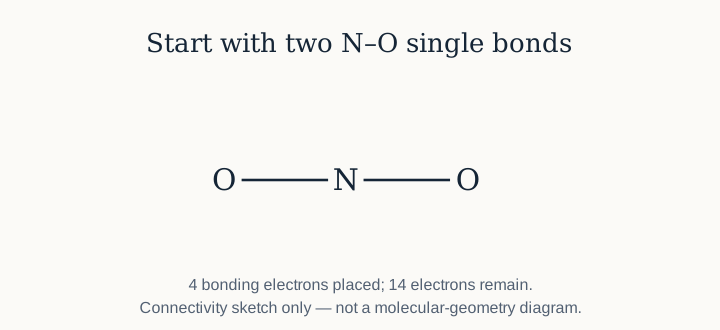
Nitrogen is less electronegative than oxygen, so it goes in the center. Start with the O—N—O single-bond skeleton. The two single bonds use 4 electrons, leaving 14 electrons to place.
Step 3Complete the outer octets
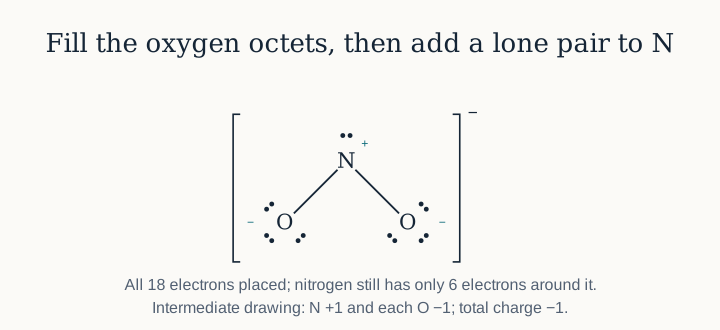
Give each oxygen three lone pairs. That uses 12 more electrons, leaving 2 electrons. Put those final 2 electrons on nitrogen as one lone pair. Both oxygens now have octets, but nitrogen needs more bonding to reach an octet.
Step 4Form one N=O double bond
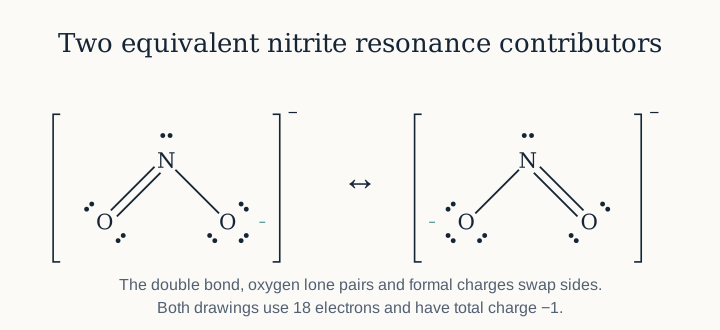
Move one lone pair from either oxygen into its N—O bond. This makes one N=O double bond and leaves the other N—O bond single. Nitrogen now has an octet; the double-bonded oxygen has formal charge 0, while the single-bonded oxygen has formal charge −1.
Step 5Draw the equivalent resonance structure
Move the double bond to the other oxygen to draw the second contributor. The two drawings use the same 18 electrons and have the same formal-charge pattern. The resonance arrow does not mean the ion switches between two separate molecules: the real nitrite ion is a hybrid with two equivalent N—O bonds.
- 18 valence electrons placed
- Nitrogen octet satisfied (one lone pair, one single bond, and one double bond)
- Each oxygen octet satisfied
- Formal charges sum to −1
- Both equivalent resonance forms shown
NO₂⁻ Valence Electrons
Nitrogen contributes 5 valence electrons. The 2 oxygen atoms contribute 2 × 6 = 12 valence electrons. After adjusting for the ion charge, NO₂⁻ starts with 18 valence electrons to place. Of those, 6 fill the bonds and 12 sit as lone pairs (O: 2, 3).
| nitrogen: 5 valence electrons |
| 2 × oxygen: 2 × 6 = 12 |
| Total: 5 + 12 = 18 |
NO₂⁻ Resonance Structures
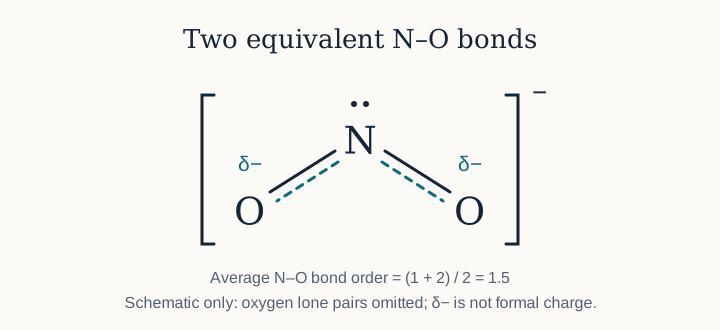
NO₂⁻ has two equivalent resonance contributors. In one, the left oxygen is double-bonded to nitrogen and the right oxygen is single-bonded with a −1 formal charge; in the other, those roles swap. The real ion is a resonance hybrid, not a fixed single bond on one side and a fixed double bond on the other. Both N–O bonds are equivalent, with an average bond order of 1.5. The resonance arrow (↔) does not show a chemical equilibrium or ions repeatedly converting into one another.
NO₂⁻ Lewis Structure with Formal Charges
Formula
Formal charge = valence e⁻ − nonbonding e⁻ − ½ × bonding e⁻
| Atom | Calculation | Formal charge |
|---|---|---|
| N | 5 − 2 − ½(6) = 0 | 0 |
| O | 6 − 4 − ½(4) = 0 | 0 |
| O | 6 − 6 − ½(2) = −1 | −1 |
The formal charges sum to -1, matching the −1 ion. Smaller formal charges mark the preferred structure.
Formal charge = valence electrons − nonbonding electrons − ½(bonding electrons).
Central N: 5 − 2 − ½(6) = 0. Nitrogen has one lone pair and one single plus one double bond.
Double-bonded O: 6 − 4 − ½(4) = 0.
Single-bonded O: 6 − 6 − ½(2) = −1.
The formal charges add to −1, the net charge of nitrite. In the other resonance contributor, the two oxygens exchange these formal-charge assignments. The negative formal charge in either one drawing does not mean the extra electron density is permanently localized on one oxygen.
NO₂⁻ Molecular Geometry
| Electron geometry | Trigonal planar |
|---|---|
| Molecular geometry / shape | Bent |
| VSEPR notation | AX₂E |
| Bond angle | ≈115° |
On the central nitrogen, count electron domains the VSEPR way: each bonded neighbor is one domain (a double or triple bond still counts as one), and each lone pair is one more. NO₂⁻ has 2 bonding domains and 1 lone pair (AX₂E), for 3 electron domains in total.
NO₂⁻ has a bent molecular geometry because nitrogen has two bonding domains and one lone pair (AX₂E).
Nitrite is AX₂E: nitrogen is A, the two N–O bonding regions are X₂, and the lone pair on nitrogen is E. Three electron domains give trigonal planar electron geometry, while the atoms alone make a bent (angular) molecular geometry. The O–N–O angle is commonly reported as approximately 115°.
Why Is NO₂⁻ Bent?
A double bond still counts as one electron domain in VSEPR. Nitrogen therefore has two bonding domains and one lone pair, not three bonding domains. The three domains arrange roughly trigonal planar; with the lone pair occupying one position, the two oxygen atoms form a bent shape.
NO₂⁻ Bond Angle
The O–N–O bond angle in nitrite is approximately 115°. A simple trigonal-planar electron-domain arrangement suggests an angle near 120°, but the lone pair on nitrogen changes the repulsions and compresses the angle. This is much smaller than the approximately 134° angle in neutral NO₂, whose central nitrogen has an unpaired electron rather than a full lone pair.
Charge Distribution and Polarity of NO₂⁻
Nitrite has a bent O–N–O framework and an uneven electron distribution. Its two N–O bonds are equivalent in the resonance hybrid, with the extra electron density spread over both oxygens. Because NO₂⁻ carries a net negative charge, it should not be classified as simply polar or nonpolar in the same way as a neutral molecule such as H₂O.
NO₂⁻ Hybridization
Nitrogen in NO₂⁻ is sp²-hybridized.
Nitrogen has two N–O bonding domains and one lone pair. In introductory chemistry, these three electron domains correspond to trigonal planar electron geometry and an sp² hybridization description. The remaining p orbital participates in the delocalized π bonding shown by the two resonance contributors.
NO₂ vs NO₂⁻: What's the Difference?
Neutral nitrogen dioxide and the nitrite ion share a bent O–N–O framework and both are represented with two resonance contributors, but their electron counts are different. Adding one electron changes neutral NO₂, an odd-electron radical, into the closed-shell nitrite ion.
The Lewis structures must therefore not be used interchangeably: neutral NO₂ has 17 valence electrons and an unpaired electron, whereas NO₂⁻ has 18 valence electrons and one lone pair on nitrogen.
| Property | NO₂⁻ | NO₂ |
|---|---|---|
| Name | Nitrite ion | Nitrogen dioxide |
| Net charge | −1 | 0 |
| Valence electrons | 18 | 17 |
| Unpaired electrons | 0 | 1 |
| Central N lone pairs | 1 | 0 complete lone pairs |
| Resonance contributors | 2 | 2 |
| Molecular geometry | Bent | Bent |
| Bond angle | ≈115° | ≈134° |
| N formal charge in one contributor | 0 | +1 |
NO₂⁻ Lewis Structure Summary
| Chemical name | Nitrite ion |
|---|---|
| Total valence electrons | 18 |
| Central atom | Nitrogen |
| Structure | O═N─O |
| N=O | Double bond |
| N–O | Single bond |
| Lone pairs on nitrogen | 1 |
| Lone pairs on outer atoms | O: 2, 3 |
| Electron geometry | Trigonal planar |
| Molecular geometry | Bent |
| VSEPR | AX₂E |
| Bond angle | ≈115° |
| Hybridization | sp² |
| Polarity | Charged ion |
| Formal charge | see formal charge table |
| Resonance | Yes |
| Overall charge | −1 |
Try Another Lewis Structure
Enter another formula to draw its Lewis structure — bonds, lone pairs, formal charges, and the steps behind them.
Related Lewis Structures
Common next structures from general chemistry — each link opens that molecule so you can compare geometry, polarity, or the drawing steps.
Frequently Asked Questions
What is the Lewis structure of NO₂⁻?
The nitrite ion has nitrogen in the center with one N=O double bond, one N–O single bond, and one lone pair on nitrogen. It is drawn as two equivalent resonance forms because either oxygen can carry the single bond and −1 formal charge.
How many valence electrons does NO₂⁻ have?
NO₂⁻ has 18 valence electrons: 5 from nitrogen, 12 from two oxygens, and 1 added for the −1 charge. The calculation is 5 + 2(6) + 1 = 18.
Does NO₂⁻ have resonance structures?
Yes. NO₂⁻ has two equivalent resonance contributors. Each has one N=O double bond and one N–O single bond; the double bond and the −1 formal charge exchange between the two oxygens. The actual ion is a resonance hybrid with equivalent N–O bonds.
What are the formal charges in NO₂⁻?
In either nitrite resonance contributor, nitrogen has formal charge 0, the double-bonded oxygen has 0, and the single-bonded oxygen has −1. The charges sum to −1, which matches the ion's overall charge.
What is the molecular geometry of NO₂⁻?
NO₂⁻ has a bent molecular geometry. Nitrogen has two bonding domains and one lone pair, so its electron geometry is trigonal planar and its VSEPR notation is AX₂E.
What is the bond angle of NO₂⁻?
The O–N–O bond angle in NO₂⁻ is approximately 115°. It is smaller than the ideal 120° associated with three electron domains because the lone pair on nitrogen affects electron-pair repulsions.
What is the hybridization of nitrogen in NO₂⁻?
In the common introductory hybridization model, nitrogen in NO₂⁻ is sp²-hybridized. Its two N–O bonding domains and one lone pair give three electron domains and trigonal planar electron geometry.
What is the difference between NO₂ and NO₂⁻?
NO₂ is neutral nitrogen dioxide with 17 valence electrons and one unpaired electron, so it is a radical. NO₂⁻ is the nitrite ion with 18 valence electrons and no unpaired electron. Both are bent and have resonance contributors, but their formal charges and bond angles differ.